Panel facilitator info
Find out handy tips and tricks for facilitating a panel at the WasteMINZ and Australasian Land & Groundwater Association (ALGA) Conference 2026.
General overview
-
Each panel discussion will be run slightly different, depending on the topic, number of panellists and discussions had during the preparation session, so please refer to your run sheet for any advice specific to your panel discussion session.
-
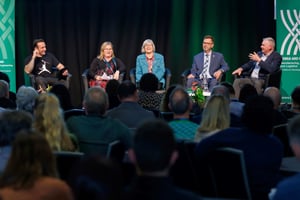
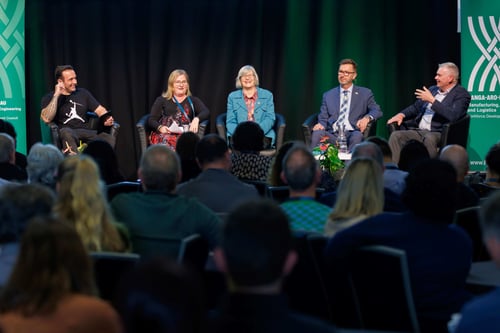
The panel facilitator is there to introduce the speakers, facilitate the discussion and Q&A from the audience, and ensure that we run to time. As indicated above in the supporting information for session chairs, we love to see our panel discussion facilitators bring some energy and personality to the room – so please feel free to reflect this in your introductions!
-
As facilitators, we would also like to encourage you to use te reo Māori if you feel comfortable to do so. Please see advice above regarding some simple phrases which you may want to incorporate when facilitating your panel discussion.
-
Just like the support for any WasteMINZ conference session, there will also be support available for the panel discussions. There will be at least one WasteMINZ volunteer or staff member in your room as well as AV tech support. The WasteMINZ staff member or volunteer will support running microphones, room setup, any technical issues and other troubleshooting.
Running the panel discussion
Before the session:
-
Know your panellists – Familiarise yourself with their bios and areas of expertise.
-
Prepare an introduction – Draft a short opening to welcome the audience, introduce the topic and your panellists.
During the panel discussion:
- Set the tone – Open with a warm welcome, overview of the session topic and introduce your panellists. Make sure to keep the introductions brief.
- Guide the conversation – Pose opening questions to the panellists and encourage a balanced participation. Keep the discussion flowing and on topic. Please see below a list of phrases that can be used to keep the conversation balanced.
- Manage time – Watch the time and gently steer panellists back if they go off-track or over time and ensure all voices are heard.
-
As facilitators, we would also like to encourage you to use te reo Māori if you feel comfortable to do so. Please see advice above regarding some simple phrases which you may want to incorporate when facilitating your panel discussion.
-
Just like the support for any WasteMINZ conference session, there will also be support available for the panel discussions. There will be at least one WasteMINZ volunteer or staff member in your room as well as AV tech support. The WasteMINZ staff member or volunteer will support running microphones, room setup, any technical issues and other troubleshooting.
Balancing the conversation
In any panel discussion, one of the key responsibilities of the facilitator is to ensure that the conversation remains engaging, balanced, and respectful of all participants. This can be challenging, especially when panellists have differing viewpoints or time constraints. Below are some helpful phrases you may wish to use to encourage participation, manage dominant speakers, and seamlessly transition between topics, ensuring a dynamic and inclusive discussion.
Encouraging participation:
- “Let’s hear from [Panellist Name] on this point.”
- “Who hasn’t had a chance to speak yet?”
- “I’d love to hear your perspective on this, [Panellist Name].”
Redirecting or managing dominant speakers:
-
“That’s an excellent point. Let’s hear from [another Panellist Name].”
- “I appreciate your insights;[another Panellist] what is your opinion?”
- “I would love to cover some more topics, let's move on to another question”
Inviting audience engagement:
- “Does anyone from the audience have a question or comment?”
- “We’d like to hear your thoughts. Please raise your hand if you have a question.”
Transitioning between topics:
- “Great discussion on that topic. Let’s shift gears to [next topic].”
- “To build on that point, [Panellist Name], what are your thoughts on [related topic]?”
- “That’s an interesting perspective. Now, let’s explore [new topic].”
Summarising and wrapping up:
- “To summarise, [Panellist Name] emphasized [key point], and [Panellist Name] added [another key point].”
- “As we approach the end of our time, any final thoughts from our panellists?”
- “Thank you all for your valuable insights today.”
Further reading on how to moderate a panel discussion

- Toastmaster International: A Panel Moderator’s Guide to Success
- Forbes: 7 Golden Rules for Successful Panel Discussions