



In this edition
- United States - Research for Environmental Uses and Sustainable Economies (REUSE) Act
- Australia and New Zealand – Meadow Kapsul technology coming to a store near you?
- Extended Producer Responsibility – Current initiatives are failing to prioritise reuse
- Breaking the Plastic Wave – 2025 update
- Great reuse articles and reports
- Slash for Cash – Not reuse, but an interesting upcycling project
United States - Research for Environmental Uses and Sustainable Economies (REUSE) Act
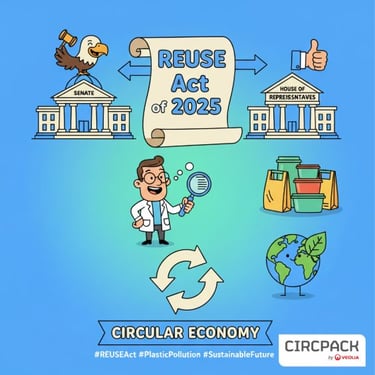
In late 2025, the United States made great inroads to developing a reuse economy with the passing of the Research for Environmental Uses and Sustainable Economies (REUSE) Act of 2025, which directs the Environmental Protection Agency to develop a report on the best practices and feasibility of reuse and refill systems in the U.S. The Bill, which was supported by both sides of the Senate, would see a report delivered that would assess the economic and environmental impacts of reuse and refill systems, including job creation potential, government requirements and barriers to implementation.
The Act comes on the back of poll results released earlier in 2025 that showed that 85% of U.S. voters support increasing the use of reusable packaging and serveware. Overall, 81% of U.S. voters said they support reducing the amount of plastic that is produced.
“There is clear bipartisan interest in solutions to address the plastic pollution crisis. Movement toward reuse and refill systems is good news for our communities, health and oceans,” says Christy Leavitt, senior campaign director at Oceana.
“Oceana applauds the Senate for saying ‘yes’ to expanding research on reuse and refill systems, and especially Senator Jeff Merkley, Democrat-Oregon, and Shelley Capito, Republican-West Virginia, for their bipartisan leadership to spearhead this bill.
“Reusable and refillable systems are a proven, sustainable solution to reduce single-use plastic, and polling shows the vast majority of American voters support reusable packaging and foodware. Now, the House must keep up this bipartisan momentum to introduce and pass the REUSE Act to help move our country toward a future with less plastic pollution.”
Australia and New Zealand – Meadow Kapsul technology coming to a store near you?
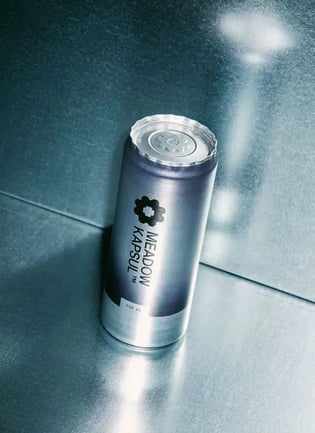 An announcement of a partnership between New South Wales-based East Coast Canning + Printing, and Sweden-based packaging technology company Meadow, to deliver resealable aluminium can technology caused initial excitement, and then confusion. Is this reuse? Or just recycling? To be honest, it's not always clear! So, what is this technology and how could it impact the Australian and New Zealand reuse and refill marketplace? Lets explore and translate what some of the buzz words actually mean.
When you think of refill options in Aotearoa, you may think of Bin Inn, refill stations at the supermarket, or using your reusable coffee cup. But there are a lot of advertised refill products on the market – liquid hand soap, dishwashing liquid, and cleaning sprays are just a few. Most options from the large manufacturers are sold in single-use plastic refill containers. Meadow Kapsul instead is an aluminium can that is placed inside a reusable dispenser (spray, pump, and various other types) for these products. Both the insert can and the dispenser can be branded and once the refill can is empty, it can be removed, recycled, and replaced. The dispenser allows the can to be effectively resealed – which ensures aromas, and liquids are contained.
So, it’s still recycling?
Yes and no – there is a reusable element to the package with the dispenser being reusable. The technology allows for the dispenser to be in a variety of shapes, and sizes. The internal can that is replaced is the recycled part.
Is it better for the environment?
The product's premise is that it removes plastic from the equation and allows scalable refill for product lines that may not have been possible before (especially scented products). The argument is that aluminium is infinitely more recyclable than plastic in terms of both the quantities that are recycled worldwide and the ease of recyclability. Is it better for the environment? This will depend on a lot of factors – what it is replacing, systems, processes, capture of that aluminium can, and where it must go to be recycled.
So, what is happening in New Zealand?
East Coast Canning + Printing have signed a strategic partnership agreement to deliver the Meadow Kapsul solution to the Australian and New Zealand market. Already well connected in the food and beverage industry, the company's initial focus will be on any uses of the product within the beverage industry. It is also looking into how this could change product delivery across health, beauty, and personal-use products in the future. Think: a shampoo in a can that can be resealed, or sauces, or pharmaceuticals. Just don’t expect to see products popping up on the shelves tomorrow.
Final thoughts?
Although reverse logistics, additional costs, and supplier hassles make implementation of a reuse system challenging, if consumers demanded it, then many of these hurdles would likely be overcome. Changing consumer habits, beliefs, and people’s lives is difficult. We know you can easily buy shampoo bars now, that have minimal packaging, similar price to traditional products and are available in major stores. However, globally it is estimated that shampoo bars make up only 0.3% of the total shampoo market (this varies wildly by country with the UK seeing solid shampoo making up 22% of the market in 2024). But people form habits and they don’t like change. Even though we know people want to reduce plastic use, it is slow to be reflected in their shopping habits. Ideally, we would see people switching to the most eco-friendly product available in a product line, but reality tells us something different.
This solution is trying to address this challenge with a solution that is familiar to people – everyone uses cans.
So, is it better for the environment? The answer is – how long is a piece of string? It is certainly a market development that is worthwhile watching to see what happens next.
RECENT OVERSEAS RESEARCH
Extended Producer Responsibility – Current initiatives are failing to prioritise reuse
An Ellen MacArthur Foundation policy brief released in December argues that current Extended Producer Responsibility (EPR) schemes direct materials to recycling when reuse and repair would retain more value, calling for fee structures that incentivise higher-value circular pathways.
EPR schemes are failing to maximise resource value because they focus on recycling and energy recovery rather than reuse and remanufacturing, according to a policy brief published by the Ellen MacArthur Foundation.
Although EPR provides dedicated funding to manage products after use, Ellen MacArthur says current schemes channel this towards lower-value pathways. Reuse and repair retain more embedded value than recycling, yet fee structures rarely reflect this hierarchy.
The Foundation calls for eco-modulated fees that vary according to repairability and reusability, not just recyclability. Under such schemes, products designed for longer use and easier repair would attract lower fees than those destined for single use and material recovery.
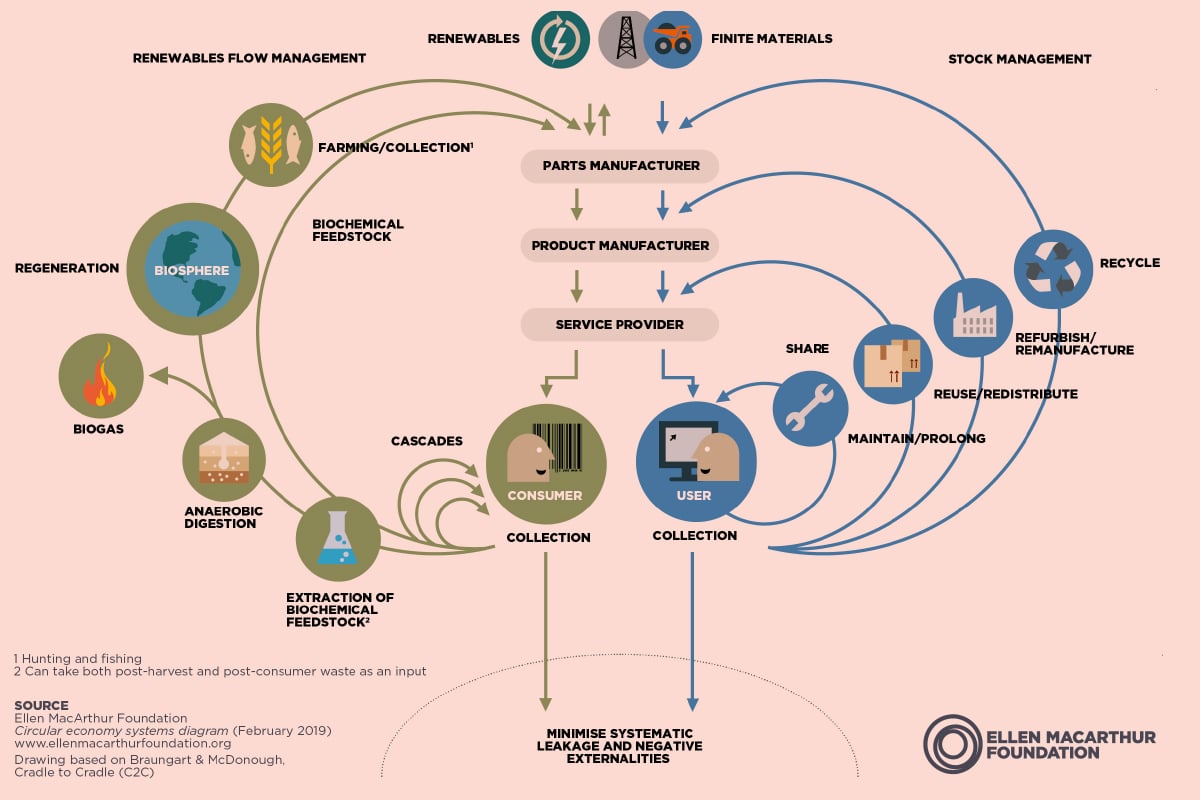
The policy brief sets out the rationale for prioritising reuse over recycling. When products are recycled, they lose the energy and labour embedded during manufacture. A reused product, by contrast, retains this value across multiple use cycles. The Foundation's 'butterfly diagram' framework (above) positions reuse, repair and remanufacturing as inner loops that preserve more value than recycling, which sits further out as a material-level intervention.
To read the full report – click here.
Breaking the Plastic Wave – 2025 update
 In 2020, The Pew Charitable Trusts and Systemiq published a report, “Breaking the Plastic Wave,” amid significant data gaps on plastic pollution, substantial debate over the scale of the plastic pollution problem and various proposals to meet the challenge. With that report, Pew and their partners sought to move the global discourse forward by identifying a credible roadmap for addressing the problem using existing solutions.
In the years since “Breaking the Plastic Wave” was released, the available data and the world’s understanding of how plastic affects people and the planet are vastly improved. In particular, researchers are paying more attention to the serious potential risks that plastic poses for human health and to its significant contributions to global greenhouse gas emissions. This wealth of information has fuelled a significant increase in efforts and policies to reduce plastic pollution around the world.
In this update, “Breaking the Plastic Wave 2025,” Pew draws on this improved information landscape to provide a deeper understanding of the environmental, economic, health and social impacts of plastic. They also explore the global plastic system’s influence on efforts to address some of the world’s greatest challenges. The aim is to support and encourage decision makers as they respond to critical global issues, evaluate trade-offs and implement solutions.
Great reuse articles and reports
 To shine a light on some great reuse in the media – check out the links below:
– On the road to reuse, big changes will make a big difference
– 3D printed sand blocks sculpt adaptable facade embracing weathering and reuse
– From Ruins to Reuse: How Ukrainians Are Repurposing War Waste
– Adaptative Reuse: Turning vacant historic mill into 88 affordable apartment homes
– California - Stores forced to stop giving out ‘reusable’ bags under new state law
– MfE – Government Waste Work Programme, released 16 December 2025
– Reusing parts from written-off patrol cars cuts costs and waste for police
– Leaf battery re-life ignoring rich NZ cache
– 'Waiting to die': the dirty business of recycling in Vietnam
– Ireland - What can be done with 11,000 tons of used wind turbine blades?
– Saxco and Revino to distribute reusable wine bottles in US
– Scotland's reuse and repair sector: a journey worth celebrating
– Japan aims to cut 25% of clothes waste by 2030 via recycling, reuse
– US – New industry standards and tech advances make pre-owned electronics more viable
– Europe tackles e-waste with eco-friendly innovation that helps reuse and repair
Slash for Cash – Not reuse, but an interesting upcycling project
 In Tolaga Bay, a unique initiative is seeking to revitalise Tairawhiti and Wairoa, post Cyclone Gabrielle. Slash for Cash, a project by The Tolaga Bay Inn Charitable Trust, transforms wood debris waste into organic biochar fertiliser and smokeless charcoal briquettes, creating sustainable solutions while generating employment opportunities for the local East Coast community.
Slash for Cash was started by Thabiso Mashaba when he arrived in Tolaga Bay from Botswana just after Cyclone Gabrielle hit.
"I literally went down to the beach because I come from a desert and I was excited to see the beach, only to find a lot of slash on the beach," he said.
Thabiso looked for a way to clean up the issue that would be sustainable and good for people and place, and he landed on Slash for Cash. He used skills he learned in Botswana to turn the woody debris littering Tairawhiti beaches into charcoal briquettes and fertiliser.
Low-cost, mobile carbonisation kilns are designed to efficiently transform wood debris waste into biochar on site. The carbonisation process ensures an environmentally friendly and efficient conversion of potential carbon and methane emissions at low temperatures.
Transforming wood debris into organic biochar fertiliser
Biochar fertiliser is made using biochar charged with sheep manure. The organic biochar fertiliser can be used as a clean, nutrient rich and cost-effective fertiliser to improve soil health, as well as providing nutrient retention and water retention for erosion prone public and private lands, gardens, farmlands, orchards and forestry fields.
Transforming wood waste into smokeless charcoal briquettes
Smokeless charcoal briquettes are made with a natural corn flour starch binder and packed into boxes. The briquettes can be used as an alternative clean and cheap fuel for cooking, barbecues and home heating.