
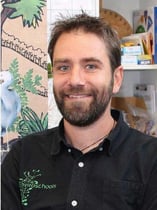
This member profile highlights the work of Scott Martin, now Clutha District Council's Waste and Greenspace Team Leader - formally the Waste Education Officer, who was recently nominated for a WasteMINZ + ALGA Waste & Resource Recovery Emerging Professional of the Year.
This article explores how his work, spanning education, infrastructure and partnerships, is contributing to meaningful change, and reflects the broader impact individuals can have across the sector.
Since stepping into the role of Waste Education Officer at Clutha District Council in 2022, Scott Martin has taken a hands-on, community-focused approach to waste minimisation. Now leading waste and greenspace activities for the council, his work reflects a steady commitment to practical change, often starting with education and local partnerships.
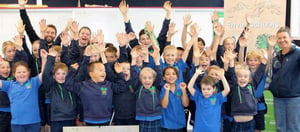
A core part of Scott’s role has been working with schools. Over the past few years, he has delivered zero waste education to hundreds of students, while also expanding the Enviroschools programme across the district. This work has focused not only on awareness, but on behaviour change - helping schools rethink how they manage waste. In some cases, the results are visible in day-to-day operations, with recycling volumes increasing and rubbish volumes declining following targeted education programmes.
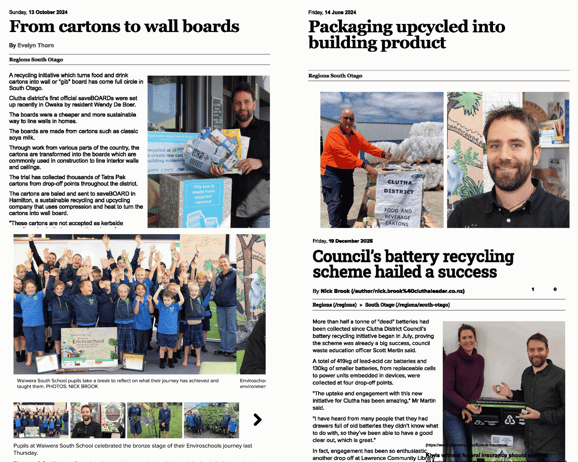
Alongside education, Scott has introduced several new recycling initiatives in Clutha. One example is the rollout of food and beverage carton recycling, which required establishing a network of collection points and partnerships to process the material. Since early 2023, the programme has collected and recycled more than a tonne of cartons, diverting these from landfill, supported by clear communication that has kept contamination low.
He has also led the introduction of battery recycling across the district. Working with Phoenix Recycling Group, the initiative set up multiple drop-off locations and has already collected over two tonnes of batteries since its launch. Removing these materials from the waste stream addresses both environmental and safety concerns, while enabling the recovery of valuable resources.
Much of this work relies on collaboration. Scott works with a wide range of groups, from local community organisations to social enterprises, to deliver waste solutions. Partnerships with organisations such as Project Bruce, Recycle South, Pakeke Lions Club in Gore and Cargill Enterprises help extend the reach of recycling services, while also supporting social outcomes. At the same time, his involvement in regional waste networks has enabled knowledge sharing and the spread of initiatives, including supporting other councils to establish similar battery recycling systems.
Community engagement remains a consistent thread. Beyond schools, Scott delivers talks, workshops and public events to build understanding of waste minimisation. Initiatives such as composting workshops and the revival of “Second Hand Sunday”, a community reuse event, provide practical ways for residents to reduce waste. Participation in these programmes has grown over time, suggesting a gradual shift in how waste is understood at a local level.
Underpinning this work is a focus on clear communication. Whether through public presentations, library displays or local media, Scott’s approach emphasises accessible and consistent messaging. This is reflected in relatively low contamination rates in kerbside recycling, indicating that residents are increasingly familiar with correct sorting practices.
Taken together, these efforts point to a model of waste minimisation that is built incrementally. Rather than relying on large-scale interventions, the approach combines education, local infrastructure and partnerships to achieve steady progress. In Clutha, this has resulted in practical changes to how materials are managed, alongside a broader shift in community engagement with waste and resource recovery.