
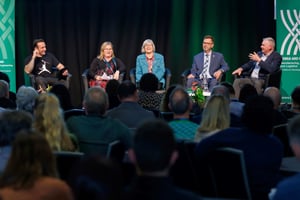
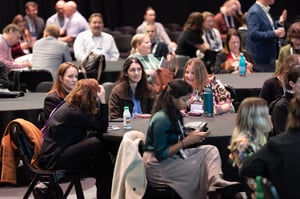
One of the highlights of the WasteMINZ + ALGA Conference 2026 was the collaborative session, where delegates came together to explore important opportunities and challenges facing our sector.
Guided by the conference theme, Mā te mahi tahi – Driving impact through collaboration, participants shared ideas and identified practical actions across four discussion topics. The summaries below capture the key themes that emerged from these conversations. A sincere thank you to our facilitators for generously sharing their expertise and guiding the discussions.
The ideas captured here will help inform wider sector conversations and contribute to the development of WasteMINZ's work programme as we continue to work with members, industry, local and central government, and other stakeholders to turn challenges into practical opportunities.
Strengthening waste licensing through cross-sector collaboration
Facilitators: Sophien Brockbank and Kimberley Hope (Tonkin + Taylor)
Participants explored how waste licensing can progress in the absence of a national framework, recognising that while a nationally consistent approach remains uncertain, there is strong sector support for improving oversight, accountability and data across the waste system. The discussion considered different pathways, including waiting for central government action, alternative data-focused approaches, and locally led licensing, with the greatest focus placed on the opportunities and challenges of council-led approaches. Participants highlighted the potential for licensing to improve access to reliable data, strengthen relationships between councils and waste operators, support Waste Management and Minimisation Plan outcomes, and provide greater visibility of waste activities where councils no longer directly deliver services. Challenges identified included the resources required to establish and maintain licensing systems, differences between council approaches, and varying capacity across waste operators to collect and report data. There was strong support for greater consistency and collaboration between councils, with the view that local and regional progress can deliver benefits now while helping build the foundations for a future national framework.
Beyond recovery: Reflections on scaling the repair economy in Aotearoa
Facilitator: Brigitte Sistig (Repair Network Aotearoa)
At this collaborative session, participants mapped regional available repair options, spanning traditional businesses, technical specialists, and community Repair Cafés, delighted to learn about repair options in different locations. Key opportunities identified included creating a comprehensive database of local repair options as well as durable, repairable products linked to Council safe disposal options, as well as establishing central city repair hubs with diverse local repairers in one accessible location. The session strongly emphasised that grounding the Repair Movement in Te Tiriti o Waitangi requires direct partnership with kaupapa Māori-led organisations like Para Kore, working in with their established marae connections and cultural stewardship. To measure true repair impact, participants advocated moving beyond simple weight metrics toward tracking item volumes, unit counts, dollar value, material age, local repair capacity, and brand quality. Communicating these outcomes through single-page visual infographics would be particularly impactful by evaluating overall product lifespan, reusable packaging, repairability, and sustainability. Finally, working group findings stressed that New Zealand’s repair regulations must mandate affordable spare parts, diagnostic tools, open product design, and stronger minimum warranties over deceptive extended ones. Introducing independent durability testing, fault tracking, and point-of-sale ratings will effectively counter planned obsolescence and hold global manufacturers accountable.
Technical Guidelines for Disposal to Land
Facilitator: Jo Ferry (Tonkin + Taylor)
This collaborative table centred around the update to the Disposal To Land Guidelines that the working group has been working on for the past 6 months. The update is based on feedback received from members and will cover most sections of The Guidelines. Discussion at the collaborative table centred around 3 aspects of the updates:
- Clarification of purpose. The Guidelines are well used within the industry, however there has been instances where it is unclear if the guidelines apply, and how they should be applied. Clarifications are being made to Section 2 of the guidelines to be clear about what it intends to cover, and what it does not cover. Discussion at the table including make sure we are not overstating what is excluded, and being careful when referring to other guidance documents as they may become outdated.
- Design section. Changes to this section are being incorporated to reflect current industry practice and recent improvements. Some things that were discussed included recommendations around daily and intermediate cover, the addition of lining for leachate ponds, and a discussion around leachate treatment. The importance of making sure the updates are pragmatic and workable was emphasised by people at the table.
- Cleanfill/background and VENM definition updates. Updates to these definitions are being made to achieve a more pragmatic, risk based approach to these materials. Additions include the introduction of “risk based background” rather than a natural background for defining acceptance criteria, and including some leniency for incidental contamination in the VENM definition. There were varied views on these changes from the people at the table.
The feedback that was received has been provided back to the working group for consideration in the update of The Guidelines. The updated draft Guidelines is due to release for consultation in late September.
How could government policy support the move from waste management to resource recovery?
Facilitator: Karen Titulaer
The session discussion highlighted that government plays a critical role in shifting from waste management to resource recovery by establishing enabling system conditions, such as setting baseline expectations, creating a level playing field for businesses, driving public behaviour change, and removing barriers for small and medium enterprises. It also emphasized the importance of government leadership in directing investment and leveraging tools like public procurement to support areas underserved by the market. To further advance a circular economy, participants recommended strengthening policy frameworks through measures such as reinstating organics diversion requirements and targeted levies, ensuring focused use of waste levies, implementing a container return scheme, and ensuring product policy is a part of the updated legislation. Additionally, there was a focus on improving understanding of product materials and additives to reduce harmful impacts and enable safer, more sustainable circular practices.